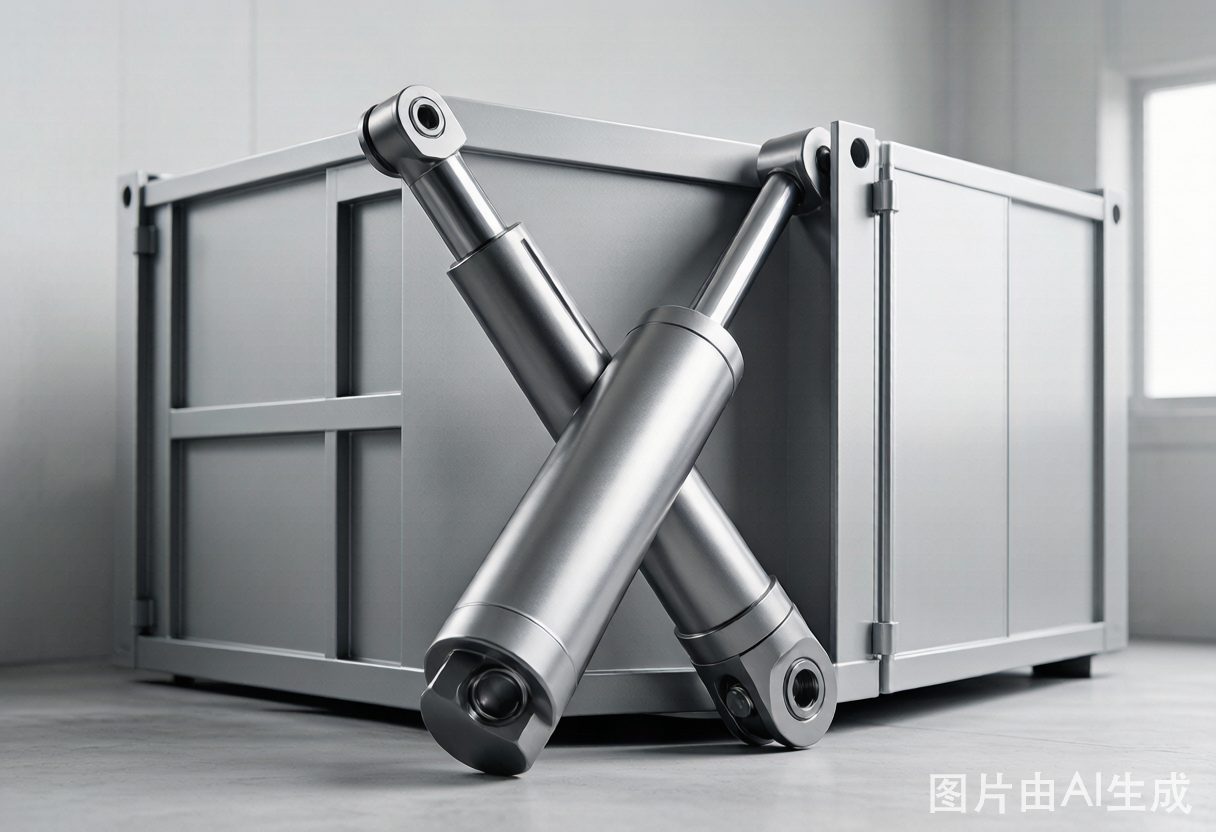
TL;DR: Choose a hooklift when your operation needs fast container swaps across multiple sites — it needs a long-stroke cylinder (up to 5200 mm) following a precise lift arc. Choose a skip loader for fixed-plant loading with shorter, higher-force cylinders that are simpler and cheaper to maintain. HCIC manufactures hooklift cylinders to HYVA-class geometry, so retrofits and new builds integrate without re-engineering the frame.
A hooklift (also called a roll-off hookloader or hook arm loader) is a hydraulic loading system that lifts, transports and tips open containers using a single hydraulically driven hook arm. Skip loaders (skip loaders or skip trucks) perform a similar duty, but lift the container with arms or chains from a lower mounting position. Both systems replace packer-style truck bodies with a chassis-mounted mechanism — but the hydraulic cylinders that drive them are engineered for completely different duty cycles.
Hydraulic architecture: why stroke and geometry differ
The defining difference is the motion profile. A hooklift arm rotates through a defined lift arc — typically 85–110 degrees — to lift the container from the ground onto the truck frame. That arc requires a very long, precisely guided cylinder stroke:
- Hooklift cylinders commonly extend from 2000 mm up to 5200 mm, often as telescopic multi-stage units to keep retracted length manageable.
- Slack-rope (rope or cable-type) skip loader cylinders typically work strokes between 800 and 1800 mm with higher buckling-resistance rod diameters.
- The hooklift cylinder must track the arm's geometry precisely; a poorly matched cylinder causes container slew, hook misalignment and frame damage over time.
Because the cylinder is the most highly stressed part of a hookloader, HCIC manufactures hooklift cylinders that match HYVA-class hookloader geometry — mounting dimensions, pin positions and stroke characteristics align with industry-standard hooklift frames, so retrofit cylinders integrate without re-engineering the vehicle frame.
Hooklift vs skip loader: side-by-side comparison
| Attribute | Hooklift | Skip Loader |
|---|---|---|
| Typical cylinder stroke | 2000–5200 mm (often telescopic) | 800–1800 mm |
| Cylinder type | Multi-stage telescopic or long single-stage welded | Single-stage welded, high buckling resistance |
| Container swap time | 60–90 seconds | 3–5 minutes |
| Best suited for | Multi-stop collection routes, variable container sizes | Fixed plant loading, construction and inert waste |
| Cylinder maintenance | Higher — long stroke, more seals, more guidance wear | Lower — simpler cylinder, easier access |
| Retrofit compatibility | Requires HYVA-class geometry match (HCIC offers direct replacements) | Frame-specific but mechanically simpler |
When to choose a hooklift cylinder
If your routes are multi-stop with frequent container swaps — municipal waste collection, recycling logistics, plant hire — hooklift speed wins decisively. A 60–90 second swap against 3–5 minutes for a skip loader compounds into hours saved per shift. Specify a cylinder that matches your frame's original geometry: HCIC's OEM replacement hooklift cylinders are built to your drawings or the frame manufacturer's specifications, with bore sizes typically from 90 to 200 mm and working pressures up to 250 bar.
When a skip loader cylinder is enough
For fixed plant loading — a single tip site, factory waste removal, construction aggregates — a skip loader's simpler cylinder is often enough. Shorter strokes mean fewer seal surfaces, less guidance wear and lower replacement cost. If downtime is your concern, keep a spare cylinder on the shelf: HCIC supplies custom OEM replacement cylinders with an 18-month warranty and a minimum order quantity of one piece, so a single spare is viable even for small fleets.
Choosing a supplier for either system
Whichever system you run, the cylinder supplier matters more than the mechanism choice. Ask for:
- Geometry documentation — mounting dimensions and lift arc data, not just bore × stroke.
- Hard-chrome plated rods and honed bores as standard, with test reports on every order.
- ISO 6020 / 6022 / 10100 compliance for interchangeability with major-brand fleets.
HCIC manufactures both hooklift and refuse collection cylinders from our Jinan facility — 210,000 cylinders per year, 95% exported, with a 48-hour quote commitment. For hooklift frames we match HYVA-class geometry; for packer and body cylinders we build to your drawings. See our hooklift and container handling cylinders or our refuse truck cylinder range, or read our field guide on refuse truck cylinder troubleshooting.
Frequently asked questions
Can I convert my skip loader to a hooklift?
Not practically — the two systems use different frame geometries, cylinder mounting points and container standards. A conversion is effectively a body replacement. What you can do is upgrade the cylinder: a geometry-matched replacement cylinder restores swap speed and safety on an existing hooklift frame.
How long do hooklift cylinders last?
With correct filtration and seal maintenance, 5–8 years in municipal duty is typical. The dominant failure modes are rod scoring from contamination and seal extrusion at end-of-stroke — both preventable. HCIC replacement cylinders ship with a test report on every order and an 18-month warranty.
Do you supply cylinders for HYVA frames?
Yes. HCIC hooklift cylinders are manufactured to HYVA-class geometry, meaning mounting dimensions, pin positions and stroke characteristics align with industry-standard hooklift frames. We build to the frame's specifications — yours or the OEM's drawings.
What is the lead time for a custom hooklift cylinder?
Typically 25–45 days for custom cylinders built to drawings; standard replacement items ship faster. Every inquiry receives a quote within 48 hours — contact our engineering team via the contact page.