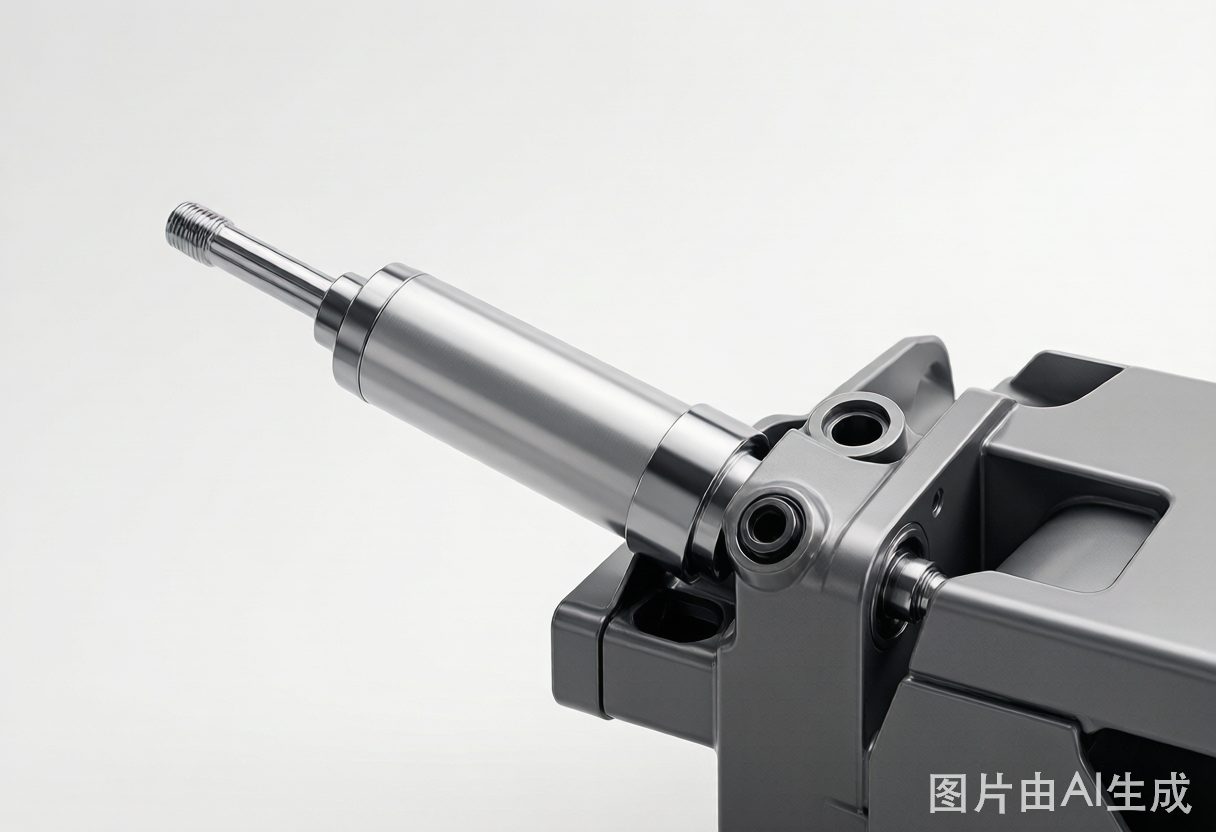
TL;DR — When packer or tailgate arms creep down with the load-holding valve closed, the oil is leaving through one of exactly two routes: past the piston seals, or past the seat of the holding valve. The open-port test tells you which route in about ten minutes, with the arms mechanically supported and one line disconnected. Replace the wrong component and the arms keep sinking — which is how a cylinder problem gets mistaken for a valve problem for a season.
What a closed valve is actually telling you
Drift on a refuse body looks mysterious from the ground, but the physics is narrow. Gravity pulls the rods in, and for the rods to move the oil behind them has to go somewhere. With the holding valve shut, only two paths remain: across the piston, or across the valve seat.
A hydraulic engineer who repairs rear loaders documented exactly this case on the tailgate-arm cylinders of a garbage truck: "the arms would slowly creep down, even when the ball valve was in the closed position, at a rate of approximately an inch per ten minutes." A drift that slow still puts the panel on the ground overnight.
The cylinders in that shop had been resealed and the load-holding valve replaced, and the client still called back: "we resealed and tested the cylinders and also replaced the load-holding valve, but they keep drifting down." Two correct-looking repairs, zero effect, because both were aimed at the wrong half of the circuit.
The open-port test
Support the arms on stands or blocks first — never rely on hydraulics to hold a load you are about to open to atmosphere. Then close the holding valve, crack the rod-end line at the cylinder, and watch the open port while the arms try to settle.
From the same case file: "the line connected to the rod end of the cylinders started to fill slowly with oil, which could only mean one thing – either one of both of the pistons were bypassing fluid from the blind to the rod end." The table below reads that result for you.
| What you observe at the open port | Where the oil is crossing | Verdict | First action |
|---|---|---|---|
| Rod-end line fills with the holding valve closed | Blind to rod end, past the piston | Piston seal bypass | Reseal or replace the cylinder |
| Rod-end port stays dry, oil weeps at the valve tank port | Across the valve seat | Load-holding valve leakage | Reseat or replace the valve |
| Both ports dry, arms still settle | No oil path at all | Mechanical: pins, mounts, structure | Check pin bores and gauge calibration |
| Drift only with the pump running | Spool leakage in the directional valve | Control valve, not the cylinder | Test the DCV spool or swap the valve |
One hour of diagnosis here saves a week of waiting for a valve that was never broken. It also protects the reverse mistake: condemning two good cylinders because nobody checked the valve first.
Why the bench test passed a leaking cylinder
The shop in that case file had a serious bench — digital sensors on both chambers, a standard protocol of cycling, pressure-testing both directions, then parking the piston mid-stroke with the blind end closed and the rod end pressurized. The resealed cylinders passed it and drifted anyway.
Three blind spots are built into that routine, and the engineer spelled them out plainly: it only detects leakage from the rod end toward the blind end, so a piston with two unidirectional seals can pass even with the blind-end seal gone; a symmetrical seal pressurized from both sides at once is not working in the condition the truck creates; and testing close to rated pressure can press a seal hard enough to close the fine scratch paths that leak at the 15 to 25 bar a packer arm actually generates.
That third point bites waste fleets hardest. A cylinder certified on a bench at 160 bar can drift on a tailgate that loads it to 20 bar, because 20 bar is exactly the pressure at which the scratch paths stay open.
The valve-first reflex and what it costs
The economics look obvious: a load-holding valve costs a fraction of a cylinder reseal, so swap the valve and see. The swap produces no information. If the drift persists, you have spent a valve and a service day to learn what ten minutes with the line open would have told you.
Run the open-port test before the purchase order, not after. If you want the theory behind how a load-holding check actually behaves under load, the counterbalance valve series at Fluid Power Journal is a sound reference for the same reasoning.
The trap on the other side: keep the small relief
There is a fast way to stop drifting arms, and it is a trap. A double over-center valve between the cylinders and the directional valve seals both lines and holds the frame. The engineer in the case file did exactly that, then caught his own mistake: "I fixed the cylinder drift, but I also made the arms capable of producing hundreds (if not thousands) of kilograms of downward force because I removed the pre-load valve that was functioning as a relief with a super-low setting of 3 bar."
Packer and tailgate arms work next to operators, bins and bystanders. That low-set relief is why a badly placed container stops the lowering arms instead of being driven through. Any drift fix must keep the force limitation in the circuit: fix the leak path, do not delete the safety.
What I ask for before quoting a reseal or a replacement
- The drift rate. Millimetres per ten minutes with the valve closed, measured on a marked rod — it sets the urgency and doubles as your proof after the repair.
- The open-port result. Which line filled. This single observation decides whether the quote is a valve or a cylinder.
- Bore, stroke and retracted length. With pin centres and port orientation, so a replacement drops in without fab work.
- The seal arrangement. A drawing or photo of the old piston — two unidirectional seals and one symmetrical band behave differently in the same bore.
- Tube condition. The case file found "metal particles embedded in the plastic guide rings", which most likely meant scratched tubes. A reseal over a scored bore is a warranty claim waiting to happen, so we ask before we quote.
Where a part number is obsolete, custom and OEM replacement cylinders work from a drawing or six measurements, and our refuse truck cylinders and compaction station hydraulics are built to ISO 6020 and 6022 geometry and pressure-tested before dispatch. When to reseal and when to replace is covered in our seals rebuild guide; the pressure-loss pattern that hides behind drift is in packer cylinder pressure loss. Holding a single-acting dump body against creep is a related but different circuit, covered on hcictec.com, and the duty-cycle side of packer hydraulics is on trailerhydraulic.com.
Sourcing without the guesswork
Send the five items above to davidsong@mail.huachen.cc or WhatsApp +8615376198599 and the quotation comes back inside 48 hours. One sample is the minimum order, first-article lead time runs 45 to 60 days, and 50 pieces or more run 30 to 45 days, confirmed against the quotation. Every cylinder carries an 18-month warranty from dispatch and ships with a full maintenance kit, built to your drawings and destination-market requirements.
Frequently asked questions
My packer arms creep down with the holding valve closed. Should I replace the valve first?
Not before the open-port test. Close the valve, support the arms, and watch which line fills with oil. Oil at the rod-end line means the piston seals are bypassing and a new valve will change nothing. Oil at the valve return port means the seat is leaking and the valve is the right spend.
Can a cylinder pass a bench test and still drift on the truck?
Yes. The common routine pressurizes the rod end with the blind end closed and watches for rod movement, which only detects leakage toward the blind side. A piston with two unidirectional seals can pass with the blind-end seal missing, and testing near rated pressure can close fine scratch paths that leak at the low pressure a packer arm generates.
Will resealing fix drift if the tube is scratched?
Not for long. Metal particles embedded in the guide rings are the tell-tale of a scored bore, and a fresh seal over the same scratch path wears at the same rate. If the tube fails a surface check, ask for a reground or new tube, or quote a replacement.
Can I stop drift by fitting an over-center valve and removing the small relief?
It will stop the drift, and it removes a safety function. The low-set relief, often around 3 bar, limits the force the lowering arms can produce next to people and property. Keep the relief in the circuit and fix the leak path instead.