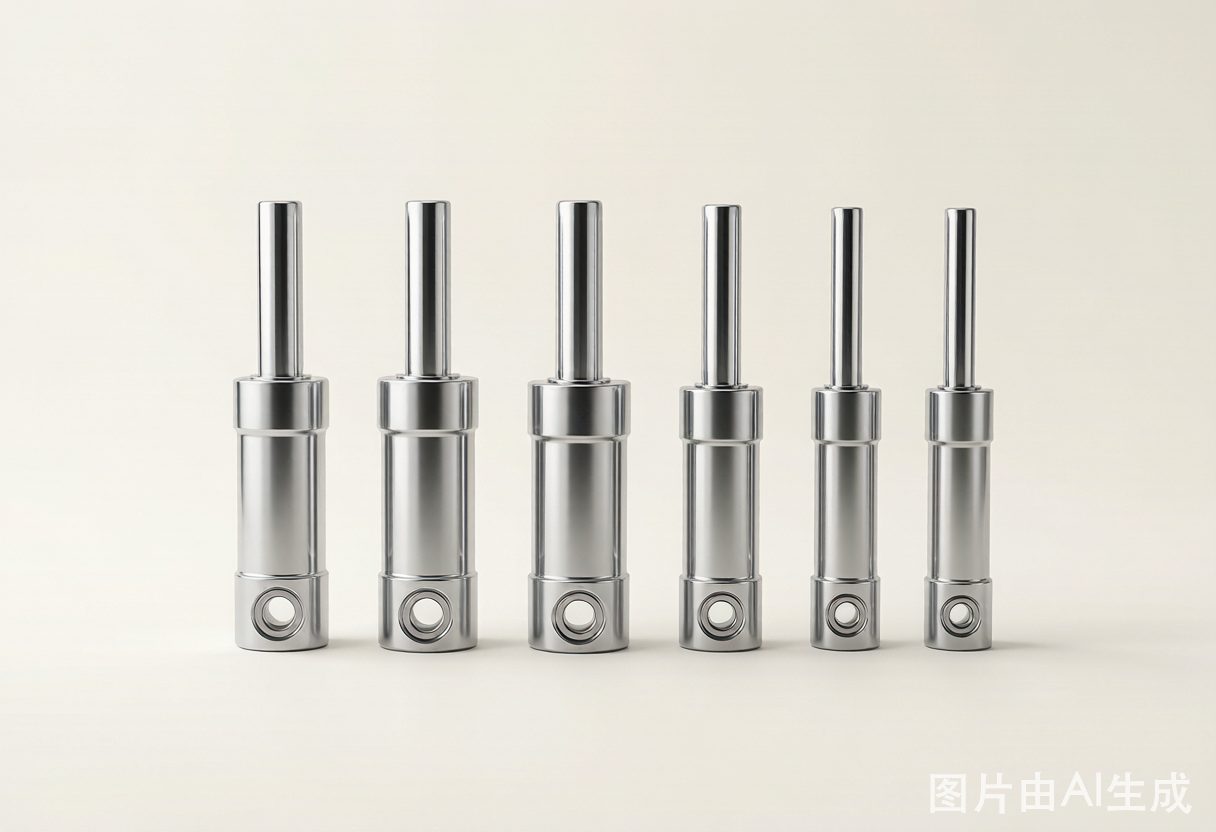
TL;DR: A short-stroke hydraulic cylinder is a cylinder whose stroke is small relative to its bore — here, roughly a 63 mm bore moving about 6 mm. It is harder to design than a pneumatic cylinder of the same size because hydraulic pressure demands minimum wall thickness, seals need axial groove space that does not shrink with stroke, and a barely-moving piston still needs guide length to resist side load. Below: the three constraints that collide, the eight parameters to send a supplier, and how a one-piece custom order is quoted.
A design engineer describing this problem on Practical Machinist put it plainly: his team needed "roughly 2.5" diameter, but with a short stroke, only about 1/4"", and had found that "the standard off-the-shelf Parker compact hydraulic cylinders won't integrate cleanly." Converted, that is a 63 mm bore with about 6 mm of travel at 1000 psi — approximately 69 bar or 6.9 MPa.
Why hydraulics rejects the pneumatic playbook
The same engineer noted that his team had "made plenty of custom pneumatic cylinders but never hydraulics." That experience transfers less than it appears to. Shop air runs at a fraction of hydraulic pressure, so a pneumatic design can treat wall section as packaging. At hydraulic pressure the wall becomes a pressure vessel, the gland a retention problem, and any extrusion gap a leak path:
- Wall thickness stops being negotiable. Hoop stress at the bore sets a minimum section; below it, the design is not "compact", it is under-designed.
- Seal extrusion clearance becomes a machined tolerance. The gap between piston and bore, and between rod and gland, has to be held — not approximated.
Three constraints that collide when the stroke is short
A long stroke gives the designer axial room to spend. Six millimetres does not. Three demands compete for the same millimetres:
| Constraint | What it consumes | Why a short stroke does not relieve it |
|---|---|---|
| Minimum wall thickness | Radial section at the bore and at the ports | Set by pressure and bore, not by stroke |
| Seal axial envelope | Piston seal groove, wear bands, rod seal and wiper stack | Groove width and stack height are fixed by seal size |
| Guide length versus side load | Bearing length between piston and rod bushing | Misalignment side load does not scale with stroke; short pistons still cock and score |
The third is where compact cylinders actually fail. A Practical Machinist member advising on this design recommended keeping "the shaft as long as possible with the piston in the middle allowing a bushing on both sides of the piston to keep it from wobbling. Even a short bushing might be better than none." That is community experience rather than a laboratory result, but it matches what we see when compact units come back scored: the bore was fine, the guidance was not.
What the source discussion established about materials and finish
The original poster asked whether the job could be done "in polished steel bores, or do we need to get everything hard-coated?" The community answer was that material selection is critical, and that honed tubing is available by the foot — a designer need not machine a bore from solid to get an acceptable surface. One member cited the ERIKS O-ring groove guidance that five-degree sloping sides suit pressures to 1500 psi, with rubbing surfaces at 8 to 16 RMS, and warned against finish below about 5 microinches for dynamic O-ring seals. Those figures come from that member's cited handbook, not from HCIC testing.
Cycle count is what turns material choice into a hard decision. The poster specified "about 5 million per year" and accepted that the customer might "spend 2 hours changing seals every million cycles," provided "the metal needs to last a lot longer." In our build experience that split is right: seals are a consumable with a planned service interval, while bore, rod and gland metalwork should outlive several seal sets.
The minimum parameter list to send a supplier
A member who builds and modifies cylinders daily responded that there were "way too many questions and parameters to answer on here." He was right — the fix is a complete first message, not a longer conversation. This is the list our engineers work from when a short-stroke RFQ arrives:
| Parameter | Why it decides the design | Value in the source case |
|---|---|---|
| Bore diameter | Sets force at pressure and the hoop-stress wall section | 2.5 in ≈ 63 mm |
| Stroke | Sets the extended–retracted delta and whether cushioning is feasible | 1/4 in ≈ 6 mm |
| Retracted (closed) length | The real packaging constraint; rules out catalog parts | Not stated — must be supplied |
| Working pressure | Wall thickness, seal selection, port rating, test pressure | 1000 psi ≈ 69 bar / 6.9 MPa |
| Cycles per year | Seal compound, wear bands, surface finish, service interval | ≈ 5 million per year |
| Mounting style | Side-load path, pin or clevis dimensions, allowable guide length | Not stated — must be supplied |
| Fluid and temperature range | Seal compound, clearances, rod finish and coating | Not stated — must be supplied |
| Port thread and clocking | Hose routing in the host module; a rotated port becomes a fabrication job | Not stated — must be supplied |
Two of the eight were missing from the original thread — the two that most often stall a quotation.
How HCIC handles a short-stroke custom order
HCIC's custom and OEM replacement cylinders are built to customer drawings across bores from 40 to 630 mm and strokes up to 12,000 mm, with working pressures to 31.5 MPa and designs to ISO 6020 / 6022 / 10100. The engineering team works from your drawing, a sample unit or the parameter list above, and returns a quotation within 48 hours with an approval drawing before production. Lead-time variables are set out in custom cylinder lead time, material choices in hydraulic cylinder materials, and gland detail in preventing cylinder leaks. Fleet buyers consolidate one-off customs through the OEM replacement program, alongside refuse truck cylinders and hydraulic power units.
- Minimum order quantity: one piece — sample and trial orders are welcome. Samples are chargeable and the sample cost is not refunded against later orders.
- Payment: T/T, 30% deposit with order and 70% balance before shipment; sample orders are prepaid in full.
- Lead time: custom-built cylinders typically 25–45 days; standard configurations ship faster, confirmed at quote.
- Quality evidence: approval drawing, a test report with every order, and an 18-month warranty. Manufactured to customer drawings and destination-country requirements; CE marking is not applied.
HCIC INTERNATIONAL GROUP CO., LIMITED (HCIC) was founded in Jinan, Shandong in 1998: three factories and one R&D centre, 250+ employees including 20+ hydraulic engineers, about 210,000 cylinders built per year, and roughly 95% of production exported.
Frequently asked questions
Why is a short-stroke hydraulic cylinder harder to design than a pneumatic one of the same size?
Hydraulic pressure is roughly an order of magnitude higher than shop air pressure, so wall thickness, seal extrusion clearance, gland retention and port rating become structural decisions rather than packaging details. A pneumatic cylinder of the same envelope can be thin-walled and lightly sealed; a hydraulic one cannot. Seal groove width also does not shrink with stroke.
What is the minimum parameter list to send a custom cylinder supplier?
Eight items: bore, stroke, retracted length, working pressure, cycles per year, mounting style, fluid and operating temperature range, and port thread with clocking. Without retracted length and cycle count, a supplier can quote a cylinder that fits the drawing but fails in service.
Can HCIC build a 63 mm bore cylinder with only 6 mm of stroke?
Yes. HCIC builds to customer drawings across bores from 40 to 630 mm, with strokes up to 12,000 mm on the long end. Send the bore, stroke, retracted length, pressure, cycle count, mounting and port specification and the engineering team returns a quotation within 48 hours with an approval drawing.
Do I need a hardened or coated bore for a high-cycle short-stroke cylinder?
It depends on cycle count, side load and fluid cleanliness. In our build experience, a honed bore with a matched seal compound suits many duties, while very high cycle counts with side load justify hardened or coated surfaces. A Practical Machinist member asking this question was advised that material selection is critical.
Topic source
This article was prompted by a real design discussion, quoted throughout with attribution:
- Thread: Design guidelines for custom hydraulic cylinder
- Community: Practical Machinist forum · posted by Borealis · 2022-01-06
- Quoted material: the poster's dimensions, pressure and cycle count; community replies on guidance, honed tubing and groove finish are reported as community experience, not as HCIC test results.